Test Your Products
Register or Login as a Vape Aware Member to test your products
The risk prediction tool enables consumers to identify products which are less harmful than others. At Vape Aware, one of our primary goals is for people to be able to make safe choices by predicting the risk of each vape tested.
Using cigarettes and other tobacco products can cause many health issues, such as cancer, cardiovascular disease, respiratory illness, reproductive problems and addiction. We use a model called the Risk Prediction Tool, which estimates the number of people out of 100,000 who will develop cancer as a result of using a particular product.
At Vape Aware, we test for compounds that are known or suspected to cause cancer. We then calculate the total quantities of these compounds that will be used over the average day, if a user vapes enough to get the same amount of nicotine as a 20-a-day smoker.
We then can work out the likely number of people out of 100,000 who will develop cancer solely from using that product using the Inhalation Unit Risk (IUR) of each compound. This is a measure of the relative potency of each compound, which allows us to compare the relative risks of each vape. In the US, the average vape has an ELCR score of 118 people who develop cancer out of 100,000. Comparatively standard cigarettes has an ELCR score of 10,000 people who develop cancer out of 100,000. The Vape Aware Risk Prediction Tool can only predict cases of cancer, however other risks to using vapes may exist outside of this.

This diagram illustrates the estimated cancer risk per 2,268 people: 3 icons represent the risk associated with vaping, 227 icons represent the significantly higher risk from smoking cigarettes, and the remaining icons indicate individuals with no excess cancer risk from either product
The ELCR considers the risk of exposure to known or potentially cancer causing chemicals based on their concentration in e-liquid or aerosol from vape products. It is intended as an estimate only, to allow for comparison of relative risk. This gives consumers an objective way to compare the relative safety, with respect to cancer, of various vape products.
The Vape Aware Relative Risk Predictor considers the most common and highest risk constituents found in vape products and their aerosols. These are chemicals that have been classified as either causing cancer or could possibly cause cancer. Chemicals classed as Group 1-3 based on the World Health Organisation International Agency for Research on Cancer (IARC) include: acetaldehyde, chromium, crotonaldehyde, formaldehyde, glycidol, lead, nickel, NNN, NNK.
Got a question for us, or a suggestion for improvement?
Please get in touch by filling out the form and a member of our team will get back to you.
Ensure your vape products meet the highest standards with our Safety Testing.
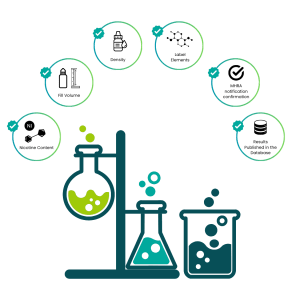
Developed to support compliance with both the UK Tobacco and Related Products Regulations (TRPR) and the EU Tobacco Products Directive (TPD), our comprehensive testing package evaluates critical safety and quality metrics, giving producers, distributors, and regulators the confidence that your products meet legal requirements.

MHRA Product Listing – Ensuring the product is registered with the UK regulator
Please note: vapes with multiple tanks, i.e. 2+10 vapes or 4-in-1 vapes, will require separate testing per pod and will be treated as separate samples.
A sample submission form will need to be completed and shipped along with the samples to our partner laboratory, Inter Scientific. A link to the sample submission form will be sent over in the order confirmation email.
Unfortunately due to the nature of our testing we are unable to return any samples once analysis is complete.
Register or Login as a Vape Aware Member to test your products
Our comprehensive testing package is specifically designed to evaluate key safety and quality metrics in line with the Tobacco and Related Products Regulations (TRPR).
Please note: vapes with multiple tanks, i.e. 2+10 vapes or 4-in-1 vapes, will require separate testing per pod and will be treated as separate samples.
A sample submission form will need to be completed and shipped along with the samples to our partner laboratory, Inter Scientific. A link to the sample submission form will be sent over in the order confirmation email.
Samples cannot be returned and will be disposed of in accordance with local environmental laws.
Register or Login as a Vape Aware Member to test your products